

 Pristupačnost

SAFIR is an institutional research project funded through the NextGenerationEU call for institutional research projects – Enhancing Scientific Excellence.
Duration: 1st October 2026 – 30th September 2029
Financing: EUR 77,682.00
Abstract:
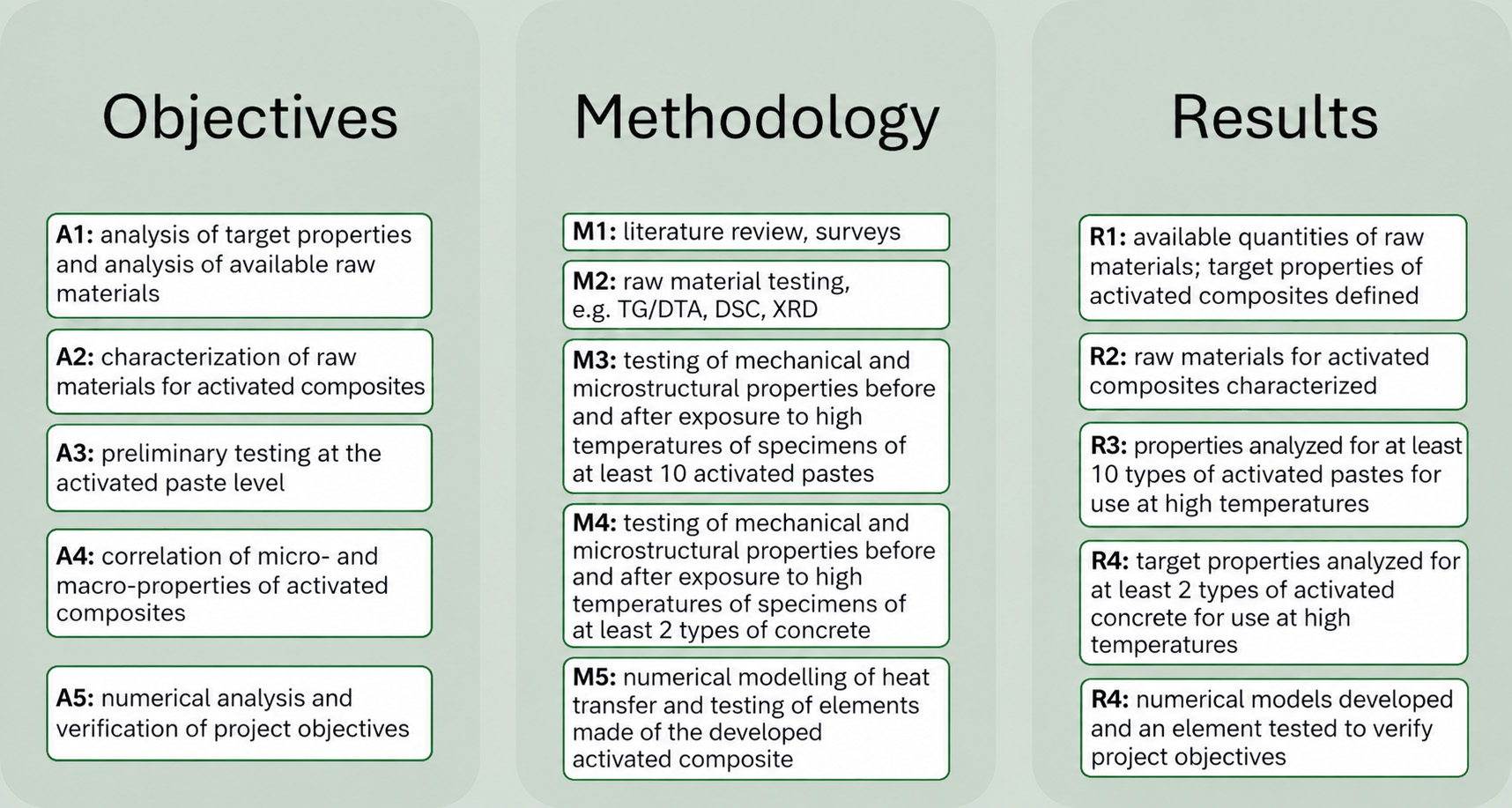
The research conducted within the SAFIR project focuses on the development of a construction product intended for use in environments with a high risk of fire-induced damage, based on activated composites derived from construction and demolition waste combined with waste materials generated by various regional industries.
Considering the adverse environmental impacts associated with the production of conventional cement-based concrete, previous research indicates considerable potential for the use of activated composites in the proposed application due to their favourable mechanical and durability properties, as well as their improved thermal stability compared with conventional concrete. The experimental programme will begin with a comprehensive characterisation of the raw materials, followed by investigation of the properties of the developed composites at the microscale and establishment of correlations with their macroscale behaviour. The final stage of the project will include numerical analyses and experimental testing required for the calibration of numerical models and verification of the project objectives. The main project outcomes will be directed towards construction material manufacturers and designers, with the aim of promoting the implementation of sustainable solutions in the construction sector.
Project team:
Conference Papers:
- Jelčić Rukavina, M.; Drakulić, M.; Runje, T.; Cvetkovska, M.; Laban, M. Ensuring Fire Safety in the Design of Concrete Tunnel Linings // 10th International Conference Civil Engineering – Science & Practice (GNP 2026) / Rogač, Milivoje (Ed.). Podgorica: University of Montenegro, Faculty of Civil Engineering, 2026, pp. 453–461.
Presentations:
- Šprem, M.; Jelčić Rukavina, M.; Baričević, A.; Serdar, M. Geopolymers Based on Construction and Demolition Waste: Potential for High-Temperature Applications // 3rd International Conference on Net-Zero Built Environment: Innovations in Materials, Structures, and Management Practices, Darmstadt, Germany, 30 September – 2 October 2026.
New Project Proposal:
- HRZZ project: LAMINATE – Low-Carbon Materials for Tunnel Infrastructure (IP-2026-1094) – submitted, not approved.
Undergraduate, Graduate and Specialist Theses:
- Šprem, M. Construction Waste as a Raw Material for the Production of High-Temperature-Resistant Geopolymeric Materials. Specialist Thesis, University of Zagreb, Faculty of Civil Engineering, 2026. Submitted for evaluation.