Opcije pristupačnosti Pristupačnost

News

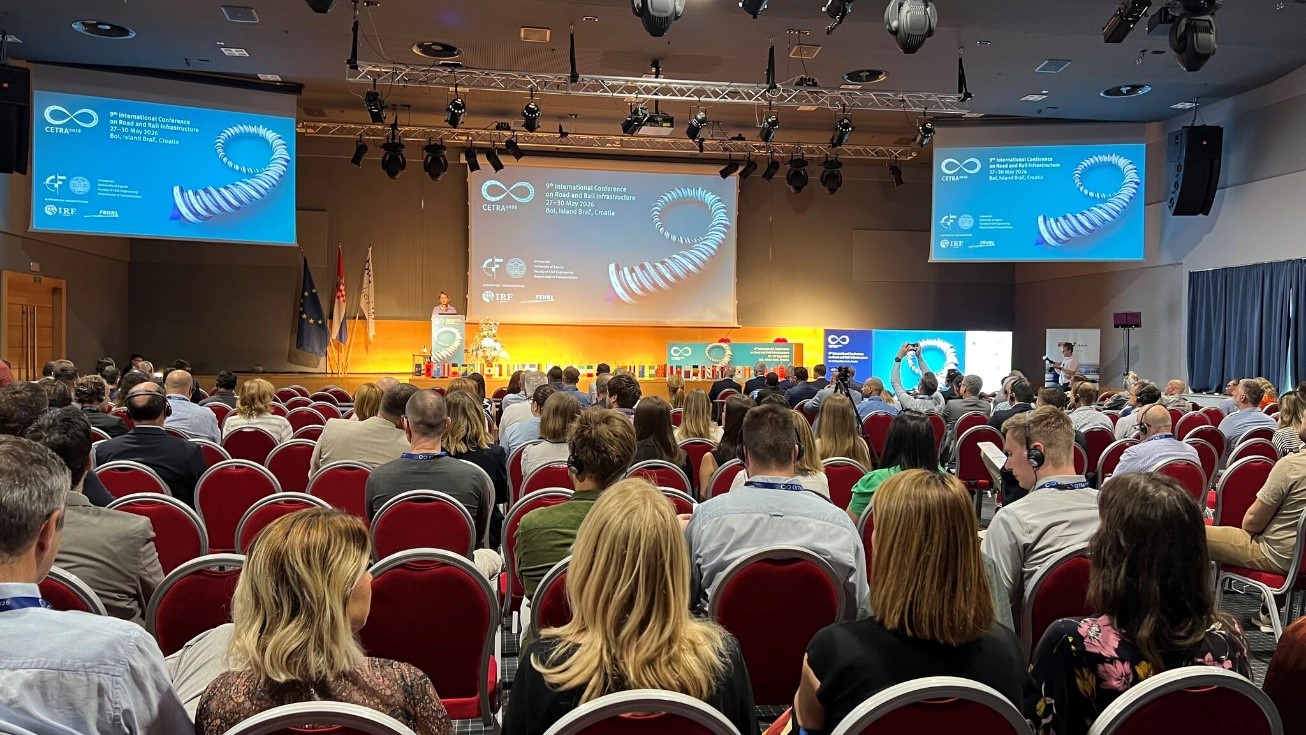
Participation in the CETRA 2026 Conference

At the 9th International Conference on Road and Rail Infrastructure – CETRA 2026, Katarina Vranešić and Ivo Haladin presented their paper entitled “Impact of Environmental Conditions on Stray Current in Urban Track Systems”. The paper examines how environmental conditions, such as moisture, precipitation and temperature, affect stray current levels in urban tramway tracks. These conditions alter the electrical properties of the track structure and the surrounding soil, particularly the rail-to-earth resistance, thereby influencing the amount of current leaking from the system. The paper contributes to a better understanding of stray current behaviour under actual operating conditions and can serve as a basis for more effective monitoring, design and maintenance of tramway tracks to reduce the risk of corrosion in urban infrastructure.

The paper is available at: https://cetra.grad.hr/archive/cetra2026papers/1806.pdf
​​


Participation in the QIRT 2026 Conference

The paper “Analyzing the condition of railway track using infrared thermography” was presented at the 18th Quantitative InfraRed Thermography Conference – QIRT 2026, held from 29 June to 3 July 2026 in Naples. The paper was authored by Katarina Vranešić, Franka Meštrović, Ivo Haladin, Krešimir Burnać and Tamara Džambas from the University of Zagreb Faculty of Civil Engineering, and Marin Kurtela from the University of Zagreb Faculty of Mechanical Engineering and Naval Architecture.

The paper presents the application of infrared thermography as a non-destructive method for assessing railway track condition. Measurements conducted at Podsused railway station revealed a clear relationship between ballast surface temperature and the proportion of fine particles: fouled ballast exhibits lower relative temperatures due to prolonged moisture retention. The paper also demonstrates how moisture penetrating concrete through capillary action manifests as a reduction in surface temperature, detectable using an infrared camera.

These findings represent an important step in the development of the method being investigated within the CORRTRACK project, which aims to use thermal imaging to detect areas of water retention beneath the concrete slabs covering tramway tracks.


​​


Paper Published in Urban Rail Transit

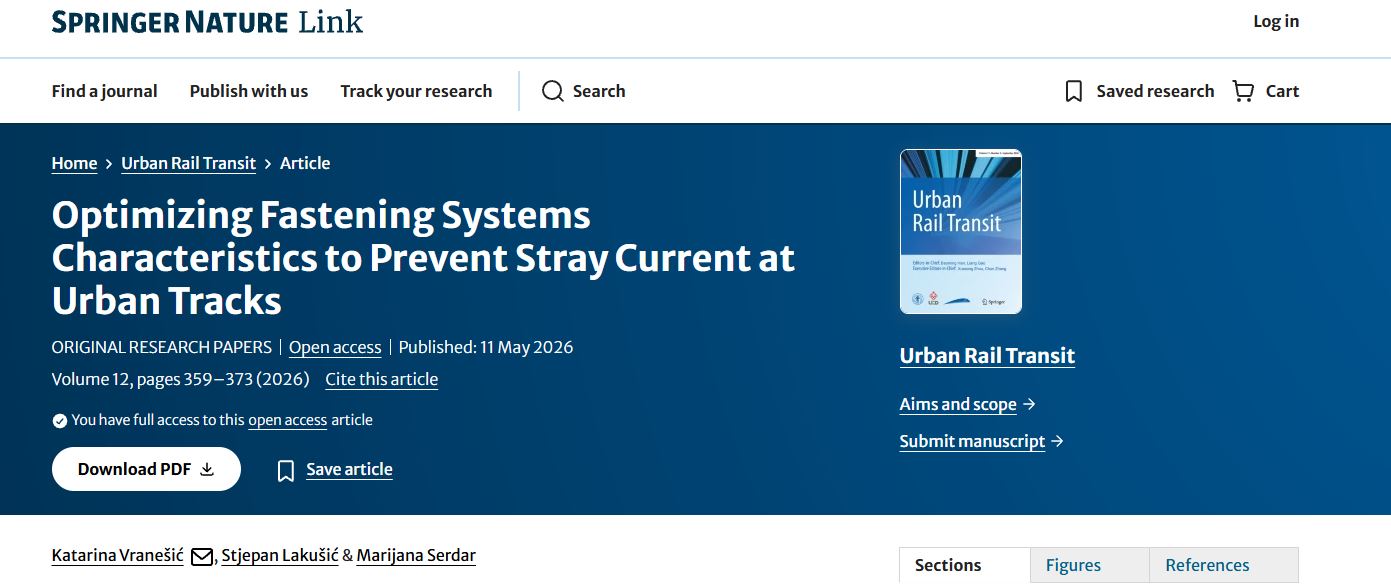
The paper “Optimizing Fastening Systems Characteristics to Prevent Stray Current at Urban Tracks”, authored by Katarina Vranešić, Stjepan Lakušić and Marijana Serdar from the University of Zagreb Faculty of Civil Engineering, has been published in the scientific journal Urban Rail Transit (Springer). The paper is available as an open-access publication.

Stray currents in tramway tracks cause corrosion of rails and surrounding infrastructure. One of the key elements in preventing them is the rail fastening system, which must electrically insulate the rail from the rest of the track structure. The study involved laboratory testing of two fastening systems, the direct fastening system (PPE) and the indirect fastening system (CTT), at a voltage of 26 V DC. Electrical resistance and potential distribution were measured, complemented by material analysis and numerical modelling using COMSOL Multiphysics. The authors emphasise the need for precise electrical resistance requirements for rail fastening systems and a standardised methodology for measuring this resistance.link.springer

Urban Rail Transit has an impact factor of 3.6 and, according to SCImago Journal Rank (SJR 2025), is ranked in the Q1 quartile in the Automotive Engineering and Urban Studies categories.

The paper is available at: https://link.springer.com/article/10.1007/s40864-026-00278-8


Workshop “Application of Ground Penetrating Radar (GPR) in Civil Engineering”

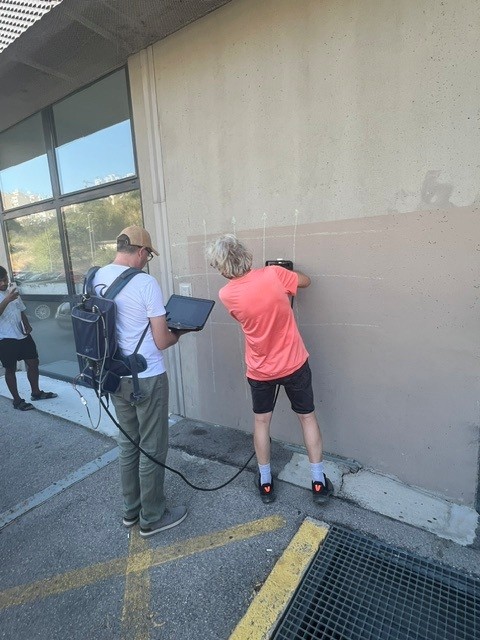
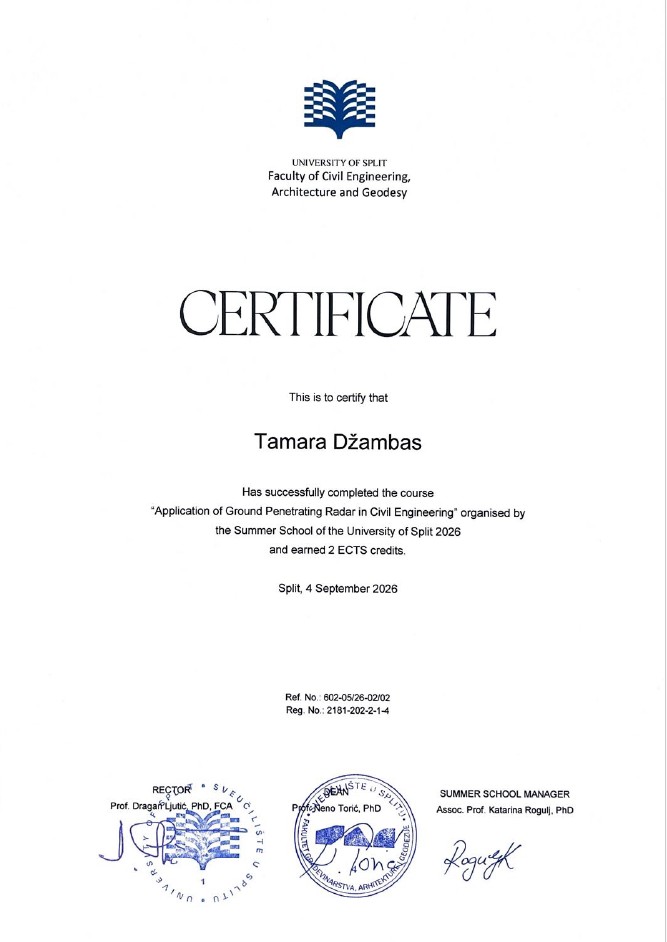
Assistant Professor Tamara Džambas participated in the workshop “Application of Ground Penetrating Radar (GPR) in Civil Engineering”, held from 31 August to 4 September 2026 as part of the University of Split’s Split Summer School 2026 programme. The workshop was organised by the Faculty of Civil Engineering, Architecture and Geodesy at the University of Split.

The five-day programme provided an introduction to ground penetrating radar technology and its applications in civil engineering, an overview of GPR systems and different antenna types, and the fundamentals of equipment operation and measurement procedures. The practical component included field measurements using a 2 GHz antenna and 200/600 MHz antennas, an introduction to other non-destructive testing (NDT) methods, and the processing and analysis of the collected data. Particular attention was devoted to the use of GPR for locating underground utilities, detecting reinforcement in reinforced concrete structures, and detecting and locating pavement damage.

The final part of the workshop focused on discussing potential applications of GPR in the participants’ respective fields of research and professional practice. This included consideration of its potential use for detecting the presence of water within tramway track structures covered with reinforced concrete slabs.

The workshop lecturers were Professor Dragan Poljak from the Faculty of Electrical Engineering, Mechanical Engineering and Naval Architecture at the University of Split, and Professor Damir Varevac from the Faculty of Civil Engineering and Architecture Osijek at Josip Juraj Strossmayer University of Osijek.